
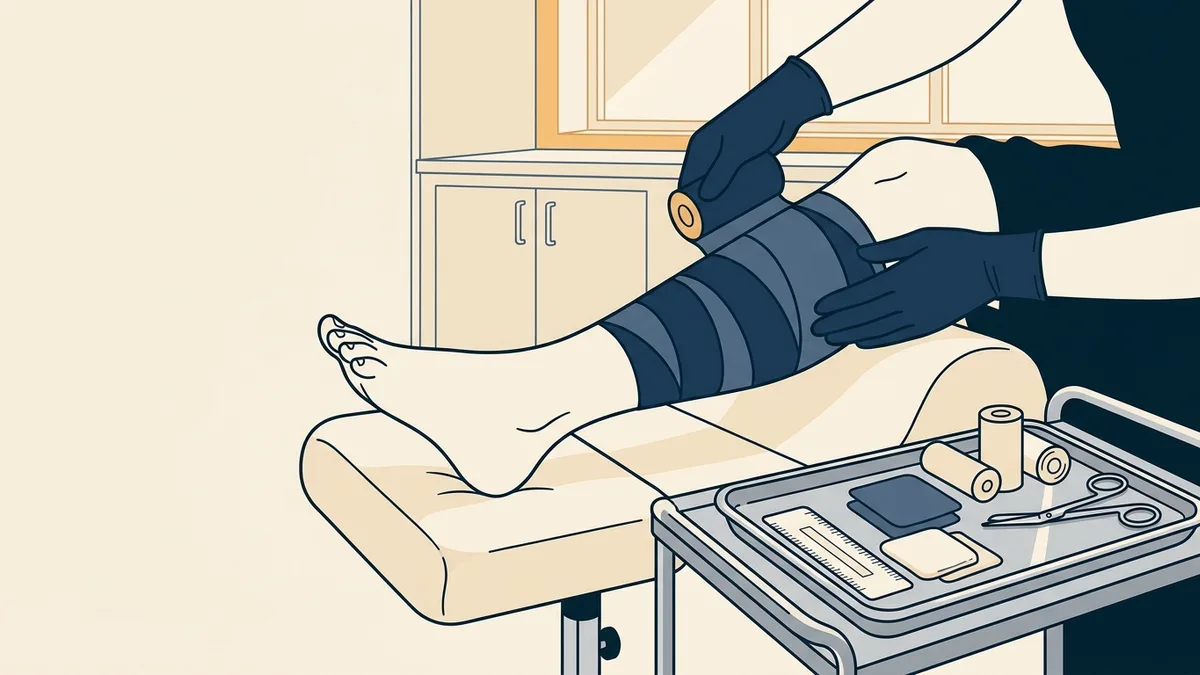
It depends on the state's wording. California lets trained podiatrists treat leg ulcers up to the tibial tubercle; Oregon allows leg wounds to the same level; Michigan and Minnesota go to the tibial tuberosity; Colorado and Maryland reach soft tissue below the mid-calf; DC reaches the knee. Texas, Washington and Massachusetts stop at the foot.
Diabetic and venous ulcers do not stop at the ankle, and wound-care podiatrists are often asked to follow a wound up the leg. Whether they may depends entirely on the state. Some practice acts give a clear anatomic line, some give a general "foot and leg," and some never leave the foot. The wording matters, because "soft tissue below the mid-calf" and "ulcers on the leg no further proximal than the tibial tubercle" are not the same permission.
Which states name a line on the leg?
- California: "a doctor of podiatric medicine with training or experience in wound care may treat ulcers resulting from local and systemic etiologies on the leg no further proximal than the tibial tubercle" (Cal. Bus. & Prof. Code 2472(f)). The rest of California's leg scope is nonsurgical treatment of the muscles and tendons governing the foot, so the ulcer provision is a specific grant tied to wound-care training or experience.
- Oregon: podiatry includes "the treatment of skin, skin-related structures and subcutaneous masses, and wounds involving skin, skin-related structures and subcutaneous masses, on the human leg no further proximal than the tibial tubercle" (ORS 677.010).
- Michigan: the practice includes "the treatment of ulcerations below the tibial tuberosity" (MCL 333.18001).
- Minnesota: podiatric medicine covers "the soft tissue of the lower leg distal to the tibial tuberosity" (Minn. Stat. 153.01).
- Colorado: "soft tissue wounds below the mid-calf," but only "if the patient is being treated by a physician for his or her underlying medical condition or if the podiatrist refers the patient to a physician" for it. A "soft tissue wound" is a lesion involving dermal and sub-dermal tissue that does not involve bone removal or repair or muscle transfer (C.R.S. 12-290-102).
- Maryland: practice includes "the soft tissue below the mid-calf" (Health Occ. 16-101).
- District of Columbia: structures and tissues of the foot and ankle and "soft tissue at or below the knee" (D.C. Code 3-1201.02).
- New York: wound care on the leg is allowed when the wound is contiguous with a foot wound being treated within podiatric scope, and "shall not, however, extend beyond the level ending at the distal tibial tuberosity" (Educ. Law 7001).
- Vermont: the human foot and "lower leg distal to the myotendinous junction of the triceps surae" (26 V.S.A. 321).
- North Dakota: the foot, ankle and "other related soft tissue structures below the tibial tuberosity that govern the functions of the foot and ankle" (N.D.C.C. 43-05-01). That language describes structures that govern foot function, which is narrower than a general wound grant.
Which states say "foot and leg"?
- Arizona: ailments of "the human foot and leg," where the leg is "that part of the lower limb between the knee and the foot" (A.R.S. 32-801).
- Florida: "ailments of the human foot and leg," with surgery limited to the area below the anterior tibial tubercle (Fla. Stat. 461.003).
- Nevada: "ailments of the human foot and leg," including treating "the effects of a systemic disease upon the foot or leg" (NRS 635.010, 635.085).
- Idaho: practice limited to the foot and leg, with surgery on the foot and ankle and soft tissue below the knee governing them (Idaho Code 54-602).
- New Hampshire: "ailments of the human foot and lower leg" (RSA 315:6).
Where does wound care need a credential or a facility?
Virginia includes "the diagnosis and treatment of lower extremity ulcers," but "the treatment of severe lower extremity ulcers proximal to the foot and ankle may only be performed by appropriately trained, credentialed podiatrists in an approved hospital or ambulatory surgery center at which the podiatrist has privileges" (Va. Code 54.1-2900).
Utah goes further than any other state read here: podiatry includes "wound debridement on the limbs and torso," but only if the podiatric physician is certified by the American Board of Wound Management as a Certified Wound Specialist Physician (Utah Code 58-5a-102, 58-5a-103).
Where is the leg outside podiatry?
Texas ("the human foot," Occ. Code 202.001), Washington ("ailments of the human foot," RCW 18.22.035) and Massachusetts ("the structures of the human foot," c. 112, section 13) do not reach the leg at all. Ohio's statute reaches "the muscles and tendons of the leg governing the functions of the foot" (ORC 4731.51), which is about function, not general leg wounds. A podiatrist moving from California or Oregon to one of these states should hand off leg ulcers that were routine at home.
Why is the wording worth reading twice?
The landmarks differ: the tibial tubercle, the tibial tuberosity, the distal tibial tuberosity, the mid-calf, the myotendinous junction, the knee. So do the conditions: wound-care training in California, physician co-management or referral in Colorado, contiguity with a foot wound in New York, hospital or ASC privileges in Virginia, board certification in Utah. Some states grant soft tissue care generally, others ulcers only. A wound-care company that rotates podiatrists through several states should keep one line per state in its scope file and train schedulers on it. The employer checklist is in wound-care companies: scope checks before a podiatrist starts, and amputation limits are in amputation limits by state.
Where can you see every state at once?
The scope by state table shows ankle, amputation and anesthesia limits with citations, marking states still being confirmed. A Podiatry Licensure Readiness Review ($149) applies it to your own training, board status and target states before you apply.
Common questions
- Can a podiatrist treat a venous leg ulcer in California?
- Yes, if the podiatrist has training or experience in wound care and the ulcer is no further proximal than the tibial tubercle (Cal. Bus. & Prof. Code 2472(f)).
- Does Colorado put any condition on leg wound care?
- Yes. A podiatrist may treat a soft tissue wound below the mid-calf only if a physician is treating the patient's underlying condition or the podiatrist refers the patient to one (C.R.S. 12-290-102).
- Can a Texas podiatrist treat leg wounds?
- Texas defines podiatry as treatment of the human foot (Occ. Code 202.001), so leg wounds are outside the license. Washington and Massachusetts are written the same way.
- Which state allows the broadest wound debridement?
- Utah allows wound debridement on the limbs and torso for podiatric physicians certified as Certified Wound Specialist Physicians by the American Board of Wound Management.
Need Help with Your Application?
We prepare the podiatry licensing process end-to-end — eligibility screening, documents, board follow-ups, and tracking.