
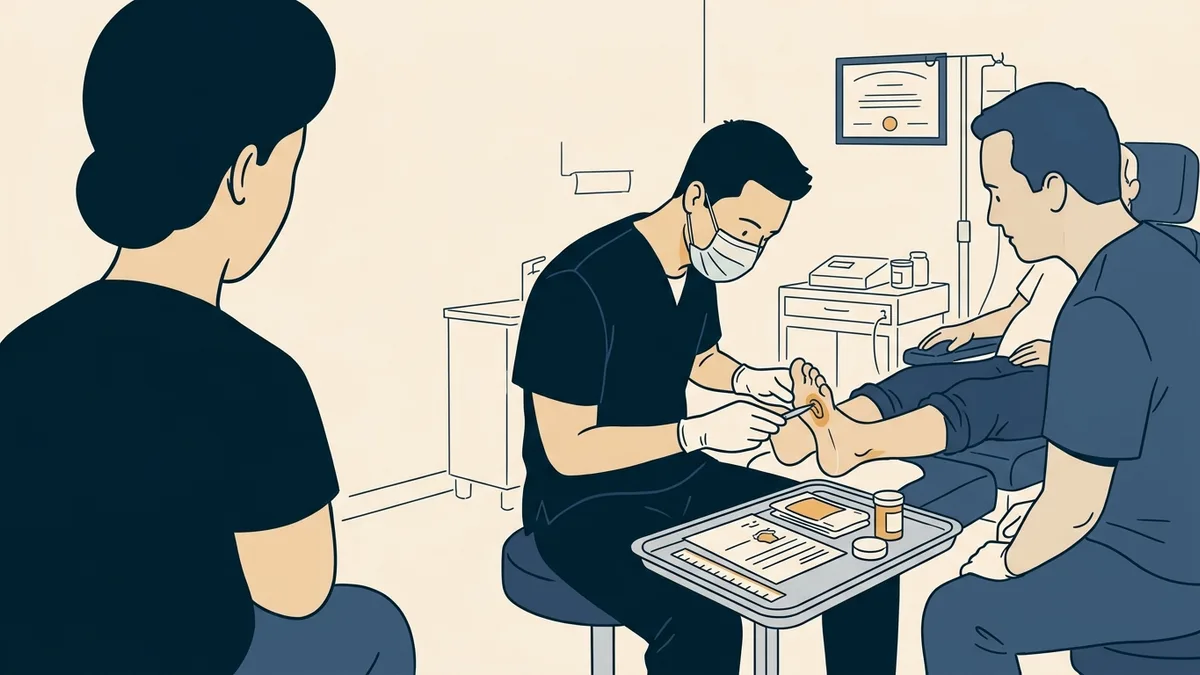
Most states require a podiatry resident to hold a resident, training or limited license before starting, valid only inside the program. California's resident license is $100 a year, New York's limited residency permit is $105 for three years, Texas charges $125, and Virginia $55. Nebraska exempts residents in CPME-approved programs while they train.
A podiatry residency is supervised practice, and almost every state treats it as practice that needs a license of some kind. The names vary (resident license, limited residency permit, training license, academic license, temporary permit), but the idea is the same: a credential that lets a graduate treat patients inside an approved program and nowhere else. Getting it on time is the first licensing deadline of a podiatrist's career, and programs that start July 1 need it in hand before the first day.
Which states require a resident license, and what do they cost?
From the statutes, rules and board pages read for the state records:
- California: a resident's license for an approved postgraduate program, renewed annually; the fee is $100 (Bus. & Prof. Code 2475, 2499.5(g)). The board's summary warns that it allows participation in a specific training program only, and that "any other activity constitutes criminal unlicensed practice."
- New York: a limited residency permit, $105, valid for three years and renewable for added one-year periods ($50 each) to finish a residency or fellowship. A New York licensed podiatrist must supervise, and "it is unlawful for the applicant to begin practice in a residency program until the limited residency permit is issued" (NYSED).
- Texas: a temporary residency license, $125 for the initial license or a renewal (16 TAC 130.60).
- Ohio: a training certificate for an internship, residency or clinical fellowship, with a $130 application fee (ORC 4731.573).
- Virginia: a limited license for interns and residents, $55 to apply and $35 to renew each year (18VAC85-20-22(F)).
- Indiana: a limited license for postgraduate training programs, with a $50 application fee (Indiana PLA).
- Colorado: a podiatry training license for residents in a Colorado program. It cannot be renewed and expires no later than three years after issue, when you leave the program, or when you receive a full license (C.R.S. 12-290-110).
- Tennessee: an academic license for practice within a postgraduate training program; the rule says the fee covers licensure during training and the initial period of full licensure (Tenn. Comp. R. & Regs. 1155-02-.06, .14).
Where do other states set limits on time or renewals?
- Maine: a podiatrist who graduated after January 1, 1991 may not practice in a residency program "without first having applied for and obtained a residency license," renewable annually up to four years in total (32 M.R.S. 3651-A).
- Delaware: a residency license for up to 24 months, renewable once (24 Del. C. 513).
- Michigan: a limited license is required for postgraduate training, confined to approved programs and renewable for up to five years (MCL 333.18012).
- Mississippi: a restricted temporary license for training programs, renewable annually up to five years (30 Miss. Admin. Code Pt. 2605, R. 3.1).
- Missouri: a two-year temporary license for an internship or residency at a Missouri hospital (RSMo 330.065).
- Nevada: a provisional license for residents, supervised, up to one year and not renewable, with a $400 application fee (NRS 635.075; NAC 635.025).
- North Dakota: a temporary permit for residents or preceptees for up to 12 months, with a fee of up to $250 (N.D.C.C. 43-05-12).
- Vermont: a limited temporary license for interns, residents and fellows, up to 54 weeks and renewable for the training period (26 V.S.A. 378).
- Rhode Island: a limited registration for interns, residents and fellows in approved hospitals or clinics, $65 (R.I. Gen. Laws 5-29-13, 23-1-54).
- Oklahoma: a training license, $50 with a $25 renewal, renewable annually (59 O.S. 144; OAC 545:35-1-2).
Other states with verified resident or training credentials include Arkansas (a one-year temporary license), Kansas (a postgraduate permit), Kentucky (podiatric residency licenses), Louisiana (a postgraduate year one registration), Minnesota (a temporary permit renewed annually), New Hampshire and Washington (training licenses), New Mexico, North Carolina and South Carolina. The state license index lists each state's current record.
Are there states that work differently?
A few do:
- Nebraska: graduates enrolled in a CPME-approved residency are outside the Podiatry Practice Act while they train (Neb. Rev. Stat. 38-3007(4)).
- Utah: for licenses on or after July 1, 2015, an applicant can be licensed after 12 months of residency while continuing a progressive Utah program, under a license that is revoked if they leave it (Utah Code 58-5a-302; R156-5a-302a).
- Iowa: graduates since January 1, 2013 need two years of CPME-approved residency for a license, then must document completion of the full residency program at their first renewal or the board will not renew (Iowa Code 149.3).
- Georgia: a limited temporary license covers podiatrists never licensed in Georgia who must practice there for 12 months or less to advance their medical education (Ga. Comp. R. & Regs. 500-3-.01).
What do resident license applications usually need?
Less than a full license, but more than many residents expect:
- Proof of your degree, usually an official transcript or diploma verification sent directly by the college.
- APMLE Parts I and II. NYSED notes that since July 1, 2011, CPME has required residents to pass both parts before beginning a podiatric residency.
- A letter or form from the program confirming your appointment and dates.
- Background checks and fingerprints where the state requires them, and state-specific training such as New York's child abuse identification coursework.
Maine, for one, says no examination is required for its residency license itself (32 M.R.S. 3651-A).
Why do resident licenses arrive late?
- Applying after the match, not after graduation. The application can usually go in once you know your program; waiting for your diploma leaves too little time.
- A transcript sent by you. California, for example, refuses photocopies and documents submitted by the applicant.
- Moonlighting or outside rotations. A resident license covers the program only. Practice outside it, even nearby, needs a full license.
- A changed rotation site. New York requires a new limited residency permit if you change employment or supervisors during the permit.
When does the resident license stop working?
When the residency ends, or sooner if you leave the program. Plan the full license application during your final year; see timing your first full license.
Resident, training, limited and temporary licenses are $299 per state through the Residency, Training or Temporary License service. You sign the application and pay the board fee; the transcript requests, program letters and tracking are handled for you.
Common questions
- Do podiatry residents need a license?
- In most states, yes. States issue resident licenses, limited residency permits, training licenses or temporary permits that allow practice only inside the approved program. Nebraska is an exception: residents in CPME-approved programs are outside its practice act while training.
- Can a podiatry resident moonlight with a resident license?
- Generally no. Resident and training licenses cover the program only. California's board summary says any activity outside the training program constitutes criminal unlicensed practice.
- Do I need to pass Part III before residency?
- No. Part III comes later. NYSED notes that since July 1, 2011, CPME has required passing APMLE Parts I and II before beginning a podiatric residency.
- How long does New York's limited residency permit last?
- Three years, with renewals in one-year periods at the Department's discretion to complete a residency or fellowship. The initial fee is $105 and each renewal is $50.
Need Help with Your Application?
We prepare the podiatry licensing process end-to-end — eligibility screening, documents, board follow-ups, and tracking.