
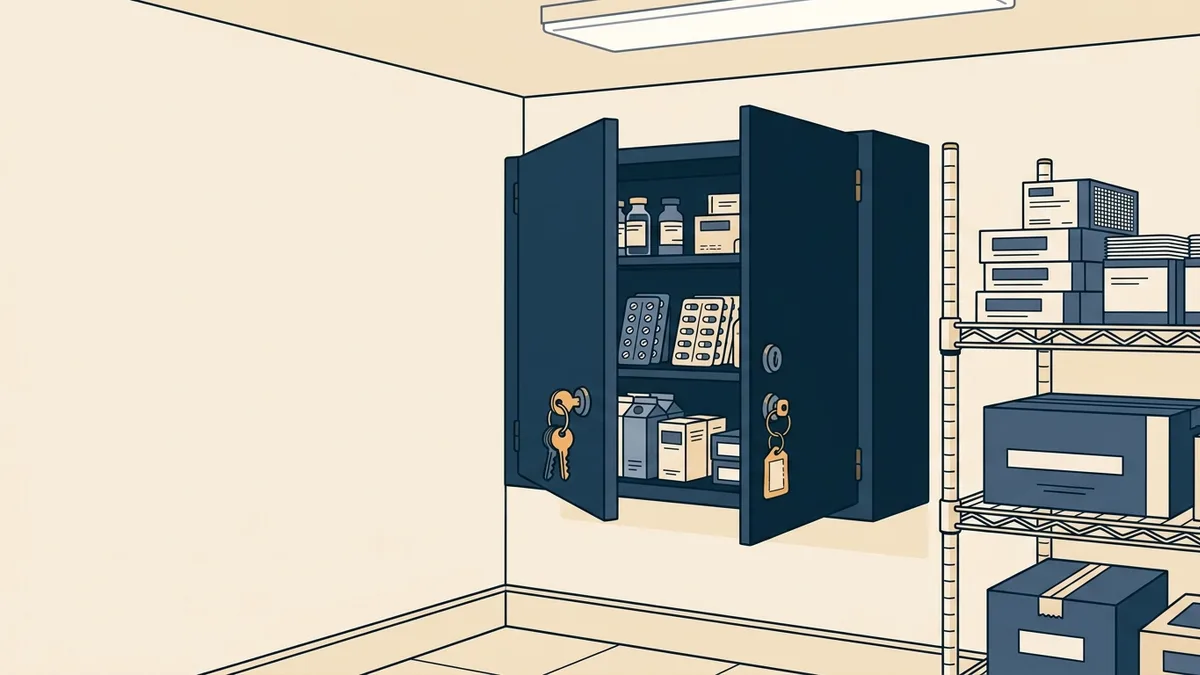
Alabama, Connecticut, Illinois, Indiana and Utah issue podiatrists a state controlled-substance registration separate from the license and the DEA number. Connecticut calls its registration a prerequisite for DEA, Indiana requires a full license first, and Illinois registers each location where controlled substances are stored. Alabama's podiatry board issues its own number for $50.
Three registrations sit behind a podiatrist's prescription pad in a new state: the state license, the federal DEA registration, and in some states a separate state controlled-substance registration. The third is the one people forget, and in several states it has to exist before DEA will register you there. The DEA side is in a new DEA registration for each practice state.
Which states issue a separate registration to podiatrists?
Alabama
All licensed podiatrists "who dispense, administer, prescribe, maintain or otherwise have in their possession controlled substances" must "annually register with the Alabama State Board of Podiatry and obtain a controlled substance number" (Ala. Admin. Code r. 730-X-3-.08). The registration is due with the annual license renewal, and both the state number and the federal number must appear on prescription blanks. The fee rule lists the controlled substance initial and renewal fee at $50 (730-X-3-.10). Unlike most states, the podiatry board itself issues the number.
Connecticut
Connecticut requires prescribing practitioners to obtain a Connecticut Controlled Substance Registration from the Department of Consumer Protection's Drug Control Division. The Department of Public Health states that this registration "is a prerequisite for the Federal Drug Enforcement Administration registration." Connecticut's podiatry statute separately authorizes podiatrists to prescribe, administer and dispense Schedule II through V drugs in connection with podiatric practice (C.G.S. 20-50).
Illinois
IDFPR lists "Podiatry Controlled Substance" as its own license type. Its application packet explains that the Illinois Controlled Substances Act "requires a separate registration for each place of business or professional practice where controlled substances are located or stored," but not for every location where they may be prescribed. The packet says a controlled substances registration "will not be issued to individuals holding a temporary license," asks applicants to mark each schedule they are applying for, and lists a $5 fee (packet updated July 2024). See the Illinois state page for the license itself.
Indiana
Indiana's Professional Licensing Agency says applicants "must have a full primary Indiana practitioner license before they can obtain a CSR," and that temporary permits and postgraduate training permits are not eligible. Podiatrist licenses and controlled substance registrations both expire June 30 of odd-numbered years, so they renew together.
Utah
Utah's podiatric physician application includes a separate controlled substance license section with an affidavit in which the applicant acknowledges the additional laws, rules and possible continuing education requirements that apply to controlled substance license holders (DOPL application).
What do these registrations have in common?
- They follow the license. Indiana and Illinois will not issue one on a temporary or training credential, and Connecticut's must exist before DEA will register you.
- They can be location-based. Illinois registers each place where controlled substances are located or stored.
- They renew on their own cycle or with the license. Alabama ties renewal to the annual license; Indiana to the June 30 odd-year license date.
- They add record keeping. Alabama, for example, requires podiatrists certified to dispense to keep an inventory and a separate dispensing record for Schedule II and III drugs dispensed in their offices (730-X-3-.09).
What happens when you leave a state?
Close the loop on both levels. Under federal rules a DEA registration terminates when a registrant discontinues professional practice, and a registrant discontinuing controlled-substance activity returns the certificate for cancellation (21 CFR 1301.52). State registrations have their own procedures, and a registration left active usually keeps its renewal and CE obligations. Before you stop practicing in a state, decide which state and federal registrations to cancel, which to keep, and what record retention the state requires for any controlled substances you dispensed there.
Do states without a separate registration add anything?
Many states rely on the license plus DEA, and add prescription monitoring and CE instead. Georgia's podiatry board, for example, tells podiatrists with DEA permits who practice in Georgia to register with the state prescription drug monitoring program, and requires 3 hours of controlled-substance prescribing CME for those who prescribe. Mandatory prescribing courses by state are collected in opioid and mandatory courses.
How should a group sequence it?
For a podiatrist starting in Connecticut, Illinois, Indiana, Alabama or Utah, prepare the state controlled-substance application alongside the license so it can go in the day the license issues, then apply to DEA for that state. Put both renewal dates on the same calendar as the license; see keeping several renewals on one calendar.
Can we prepare it?
Yes. The DEA & State Controlled-Substance Registration service is $199 per state (pricing) and covers the state registration and the DEA registration for that state. You sign the applications, and the agencies' fees are paid by you directly.
Common questions
- Do I need a state controlled substance license in Illinois?
- Yes. IDFPR issues a separate Podiatry Controlled Substance license, and the state act requires a registration for each place where controlled substances are located or stored. Temporary license holders are not eligible.
- Which comes first in Connecticut, the state registration or DEA?
- The state registration. Connecticut's Department of Public Health calls the Department of Consumer Protection registration a prerequisite for the federal DEA registration.
- Can I get an Indiana CSR on a temporary permit?
- No. Indiana's Professional Licensing Agency requires a full Indiana practitioner license first; temporary and postgraduate training permits are not eligible.
Need Help with Your Application?
We prepare the podiatry licensing process end-to-end — eligibility screening, documents, board follow-ups, and tracking.