
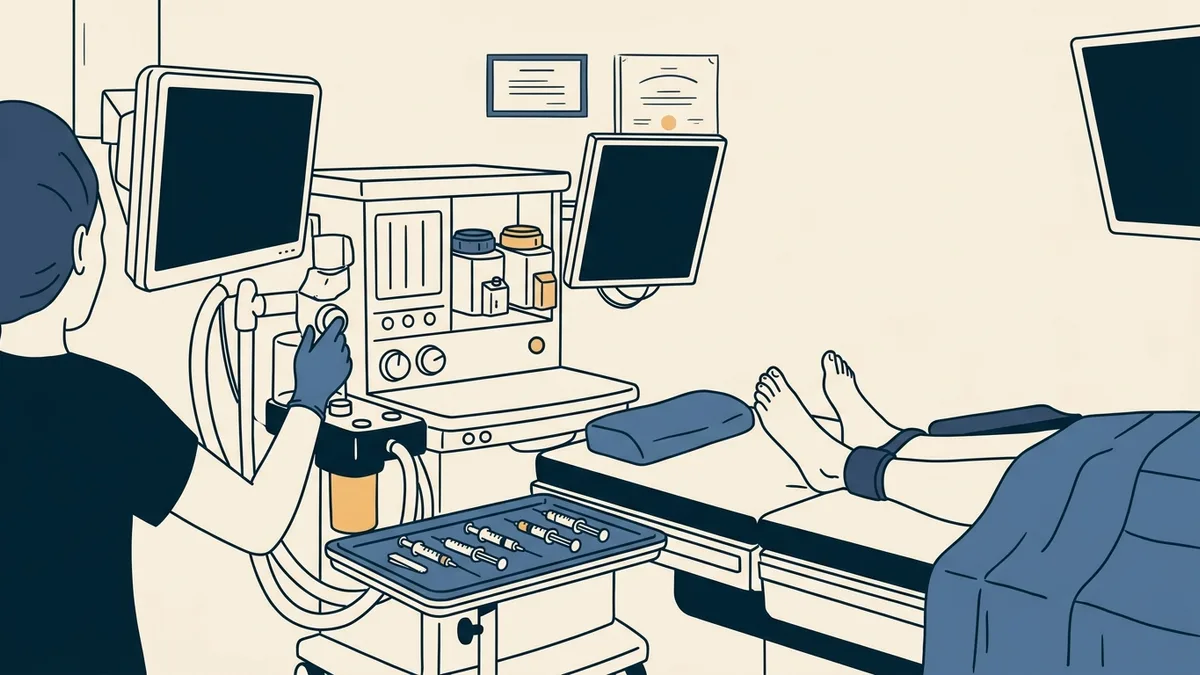
Most states let podiatrists give local anesthetic only. California, Massachusetts, Colorado, Maryland and North Carolina say so directly; Washington bars any anesthetic that renders the patient unconscious; Missouri bars general anesthetics. Wisconsin and Maine allow general anesthesia under a physician, Ohio limits it to hospitals but since June 9, 2026 protects office collaboration with CRNAs.
Anesthesia is the part of podiatric scope that most often surprises a podiatrist who moves. In one state a bunionectomy under general anesthesia in an ambulatory surgery center is routine. In the next, the statute says the podiatrist may use local anesthetic only, and anything more must come from someone else, in a specific kind of building. Hospitals and ASCs add their own rules, but the practice act sets the outer limit.
Which states allow podiatrists local anesthetic only?
A large group of statutes limits the podiatrist to local anesthesia. In most of them the limit is on what the podiatrist administers; another licensed professional may still provide other anesthesia where facility rules allow.
- California: "A doctor of podiatric medicine shall not administer an anesthetic other than local. If an anesthetic other than local is required for any procedure, the anesthetic shall be administered by another licensed health care practitioner who is authorized" to give it (Cal. Bus. & Prof. Code 2472(c)).
- Massachusetts: treatment "without the use of other than local anesthetics" (M.G.L. c. 112, section 13).
- Colorado, Arizona, Kansas, Montana, Nebraska and Hawaii exclude any anesthetic other than local from podiatry (C.R.S. 12-290-102; A.R.S. 32-801; K.S.A. 65-2002(b); MCA 37-6-102; Neb. Rev. Stat. 38-3005; HRS 463E-1).
- Maryland: "Practice podiatry" does not include administering "an anesthetic, other than a local anesthetic" (Health Occ. 16-101).
- Alabama: podiatry excludes "the administration of any anesthetic other than local" (Ala. Code 34-24-230(9)).
- North Carolina: excludes "the administration of an anesthetic other than local" (G.S. 90-202.2(a)).
- South Carolina: local anesthesia "defined as localized infiltration only" (S.C. Code 40-51-20(5)).
- Wyoming: "A podiatrist may not administer any anesthetic other than local," and general anesthesia "shall be administered in a hospital by an anesthesiologist or certified nurse anesthetist" (W.S. 33-9-101).
Other statutes simply list local anesthesia among the podiatrist's authorized acts without saying more: the District of Columbia ("A licensed podiatrist may administer local anesthesia," D.C. Code 3-1201.02) and Nevada (NRS 635.085). Read the rest of the act, and the facility's rules, before assuming anything beyond local is available.
Where is the line drawn at general anesthesia or unconsciousness?
- Washington: podiatrists may not "administer spinal anesthetic or any anesthetic that renders the patient unconscious" (RCW 18.22.035).
- Missouri: podiatry excludes "administration of general anesthetics" (RSMo 330.010).
- New Hampshire: the certificate "shall not authorize the licensee to administer general anesthesia" (RSA 315:6).
- Idaho: surgical treatment excludes "the administration or monitoring of general anesthesia" (Idaho Code 54-602).
- Michigan: podiatric medicine and surgery excludes the administration of intravenous anesthetic agents and of general anesthesia (MCL 333.18001).
Which states allow more with a physician or anesthesia professional involved?
- Wisconsin: podiatry does not include "the use of a general anesthetic unless administered by or under the direction of a person licensed to practice medicine and surgery" (Wis. Stat. 448.60(4)).
- Maine: general anesthesia is permitted "when administered or supervised by a medical or osteopathic physician who assumes responsibility" for it (32 M.R.S. 3551).
- West Virginia: anesthesia other than local for foot surgery must be given by or under the direction of an anesthesiologist or certified registered nurse anesthetist, and a physician must make a medical evaluation of the patient first (W. Va. Code 30-3-4).
- Vermont: if spinal or general anesthesia is required, a health care professional authorized to administer it must do so (26 V.S.A. 321).
- New York: podiatry includes "administering only local anesthetics for therapeutic purposes as well as for anesthesia and treatment under general anesthesia administered by authorized persons" (Educ. Law 7001).
Where does the building decide?
Ohio allows general anesthetics "only in colleges of podiatric medicine and surgery in good standing with the state medical board and in hospitals approved by the joint commission or the American osteopathic association" (ORC 4731.51). A newer section, 4731.513, effective June 9, 2026 under House Bill 52, says the State Medical Board "shall not prohibit a podiatrist who practices other than in a hospital or college of podiatric medicine and surgery ... from collaborating with a certified registered nurse anesthetist." For Ohio office and ASC podiatrists, that is the most significant anesthesia change in years. Ohio's licensing route is covered in Ohio podiatry licensing.
Oregon includes in podiatry treatment involving general or spinal anesthetic only if it is performed in a licensed hospital or ambulatory surgical center, while podiatry itself "does not include administering general or spinal anesthetics" (ORS 677.010).
Iowa lets a podiatric physician administer local anesthesia, and allows the deeper, drug-induced form of anesthesia that its statute names only in a hospital or an ambulatory surgical center (Iowa Code 149.5).
Can podiatrists use nitrous oxide?
Minnesota excludes anesthetics other than local except under section 153.26, which allows an oxygen and nitrous oxide mixture only if the patient is not rendered unconscious, the nitrous oxide is 70 percent of the mixture or less, it is given by nasal inhalator with a scavenging system, someone other than the podiatrist monitors the patient and equipment, both have completed an approved nitrous oxide course and a CPR course, it is not combined with any other analgesic or calming drug, and the machine has specified safety features.
Texas requires a Nitrous Oxide Permit before a podiatrist uses nitrous oxide for podiatric purposes. The Texas Department of Licensing and Regulation lists a didactic and clinical course directed by a qualified licensed practitioner with at least 4 hours of didactic work and 6 hours of supervised clinical experience, a separate continuing medical education course in nitrous oxide and oxygen inhalation that includes emergency management, and both basic and advanced CPR. The fee is $50 (16 TAC 130.60), the certificate is valid two years, and TDLR may inspect the office without notice. The Texas hyperbaric permit is covered in hyperbaric oxygen permits.
What equipment does Minnesota require for nitrous oxide?
Minnesota's statute is unusually specific about the machine. It must have an automatic shutoff valve if oxygen falls below three liters per minute, an immediately available oxygen flush with a positive pressure mask, an automatic control that keeps oxygen from falling below 30 percent of the mixture at maximum nitrous oxide flow, and color-coded valves, tanks and knobs with pin index and diameter index safety systems (Minn. Stat. 153.26). The courses for the podiatrist and the monitoring assistant must have been completed after December 31, 1986, and the nitrous oxide course must be approved by a school of podiatric medicine.
Does "local only" settle every question?
Not always. South Carolina defines local anesthesia for podiatrists as "localized infiltration only" (S.C. Code 40-51-20(5)), which is narrower than the plain words "local anesthetic" in many other states. If your practice relies on regional nerve blocks, ask the board in a state with narrow language how it reads the statute before you schedule cases, and get the answer in writing. The same applies to office-based cases in Ohio after House Bill 52: the statute now protects collaboration with a CRNA outside hospitals, but the State Medical Board's rules and the facility's policies still govern how that collaboration works.
Which three questions belong in every anesthesia check?
Three questions belong in every scope check for a new state:
- What may the podiatrist personally administer? Usually local only.
- Who may provide anything more for a podiatric case, and under whose direction? A physician, an anesthesiologist, a CRNA, or "another licensed health care practitioner."
- Where? Some states name hospitals, ASCs or both.
Ambulatory surgery center credentialing committees answer the same questions for their own building; that side is handled by our sister site, White Glove Credentialing. For ankle and amputation limits, see ankle surgery scope and amputation limits, or the full scope by state table.
How can we help?
Our Podiatry Licensure Readiness Review ($149) checks anesthesia, ankle and amputation scope for each state on your list. For a Texas nitrous oxide permit, the Procedure Permit service ($199 per permit) assembles your course certificates and CPR cards and files the application you approve. You complete the training and pay TDLR's fee directly.
Common questions
- Can a podiatrist give general anesthesia?
- Generally not personally. Most statutes limit the podiatrist to local anesthetic. Some allow general anesthesia for podiatric cases when an anesthesiologist, CRNA or physician gives or directs it, often in a hospital or ASC.
- What changed in Ohio in 2026?
- ORC 4731.513, effective June 9, 2026, bars the State Medical Board from prohibiting podiatrists who practice outside hospitals and podiatric colleges from collaborating with a certified registered nurse anesthetist.
- Do I need a permit for nitrous oxide in Texas?
- Yes. TDLR requires a Nitrous Oxide Permit, with at least 4 hours of didactic and 6 hours of clinical training, a CME course and CPR. The fee is $50 and the permit lasts two years.
- Does Washington let podiatrists use spinal anesthesia?
- No. RCW 18.22.035 bars podiatrists from administering spinal anesthetic or any anesthetic that renders the patient unconscious.
Need Help with Your Application?
We prepare the podiatry licensing process end-to-end — eligibility screening, documents, board follow-ups, and tracking.