
Ohio must license a podiatrist who holds a license in another state under Revised Code 4731.52(E) and chapter 4796, if the license is substantially similar, has been held at least one year, the podiatrist practiced in at least one of the last five years, and every license is in good standing. The board may waive the time requirements.
Ohio is one of the easier states for a podiatrist who is already licensed somewhere else. Podiatrists are licensed by the State Medical Board of Ohio, and Revised Code 4731.52(E) says the board "shall issue" a podiatry license under chapter 4796 to an applicant who "holds a license in another state." Chapter 4796 is Ohio's universal occupational license recognition law, and it replaces the old idea of reciprocity with a short list of conditions that do not depend on what your home state would do for an Ohio podiatrist.
What does Ohio's universal recognition law require?
Under Revised Code 4796.03, the board issues the license when it finds that you:
- hold a substantially similar license in another state authorizing the same profession;
- have held it for at least one year immediately before applying, and have actively practiced for at least one of the five years before applying (the board may waive both time requirements);
- are in good standing in every jurisdiction where you hold a podiatry license;
- had to meet education, training or experience requirements, or pass an exam, to get the other license;
- have not surrendered a license, or had one revoked, because of negligence or intentional misconduct;
- pay the fee the board sets, which the law ties to its renewal fee, its initial fee or its prior out-of-state fee; and
- have no conviction or guilty plea that would disqualify you under Ohio law.
Section 4796.08 lets the board require a state law exam only if it requires one of all applicants, and requires the same criminal records check other applicants get. Sections 4796.12 and 4796.13 let the board apply its ordinary rules on time away from practice and past discipline. A disqualifying offense does not always end the application: under 4796.10 the board may issue a restricted or limited license instead.
The bar is low on years. North Carolina wants five years, three in a reciprocating state; Connecticut's simplest route wants four. Ohio wants one year licensed and one year of practice in the last five. That makes it a good first additional state for a podiatrist a year or two out of residency. Our post on universal recognition laws and podiatry compares Ohio with other states that have similar laws.
Which parts of the standard application still apply?
The universal recognition route sits inside the ordinary podiatry statute, so it helps to know what the standard application asks for. Revised Code 4731.52(A) requires an applicant who is at least 18, has a high school diploma and at least two years of undergraduate work, holds a degree from a podiatric college in good standing with the board, has completed one year of postgraduate training in a podiatric internship, residency or clinical fellowship, and has passed the exam set by board rule. The application includes an attestation that the information is accurate and truthful, which you sign, and a consent to release your information. The fee is $305 and is not refundable.
The statute also sets the board's clock. It must finish any investigation within 90 days after a complete application, unless you agree to an extension or it finds a substantial question of a violation, and issue the license within 45 days after deciding there is no violation.
Does an Ohio license name the ankle?
Ohio's scope is written differently from most states. Revised Code 4731.51 defines podiatry as treatment of "ailments of the foot, the muscles and tendons of the leg governing the functions of the foot; and superficial lesions of the hand other than those associated with trauma." The definition does not name the ankle. A podiatrist may treat local manifestations of systemic disease in the hand and foot, but must refer the patient to an MD or DO for the systemic disease at the same time. Therapeutic x-ray and radium are excluded. Since 2021, podiatrists may also give influenza and COVID-19 vaccinations to patients seven and older (4731.512). The scope by state page puts Ohio next to states that list the ankle explicitly.
How do anesthesia and hyperbaric oxygen work in Ohio?
Anesthesia. Section 4731.51 limits general anesthetics to colleges of podiatric medicine in good standing with the board and hospitals approved by the Joint Commission or the American Osteopathic Association. A newer section, 4731.513, effective June 9, 2026 (House Bill 52), says the board may not prohibit a podiatrist practicing outside a hospital or podiatric college from collaborating with a certified registered nurse anesthetist. See anesthesia limits by state.
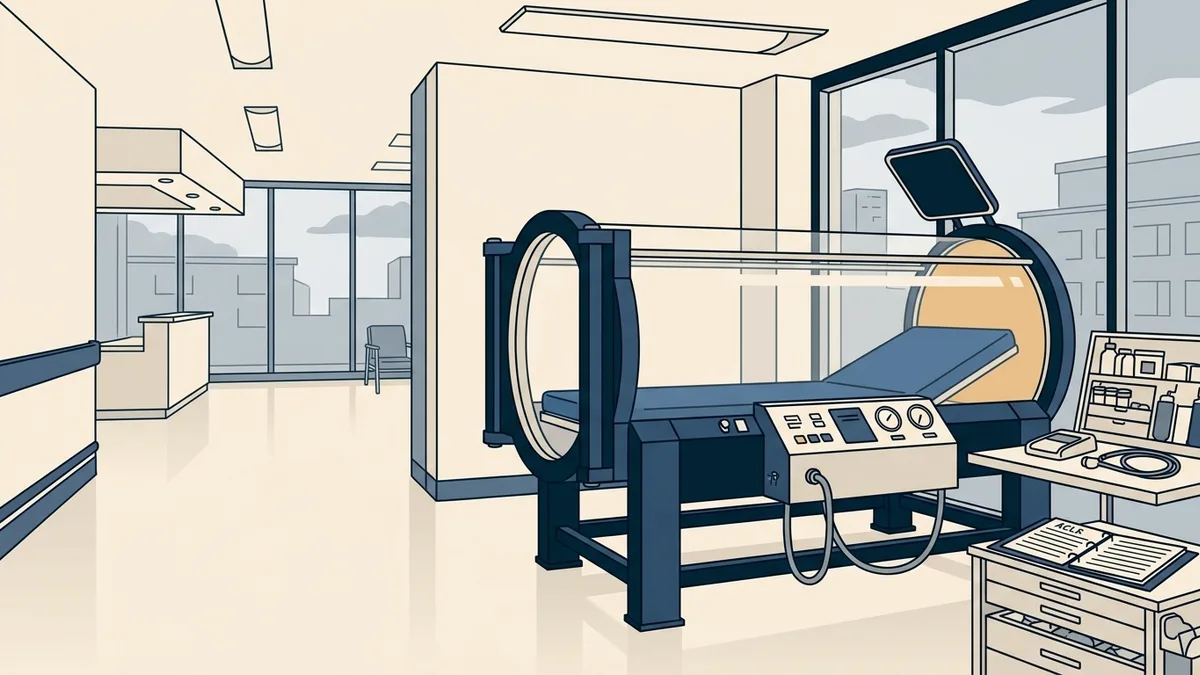
Hyperbaric oxygen. A podiatrist may order hyperbaric oxygen for conditions within podiatric scope, and may supervise it under 4731.511 if all of the following are true: the podiatrist has consulted a physician the facility authorizes to perform hyperbaric oxygen therapy; holds ACLS certification; has completed at least a 40-hour introductory hyperbaric medicine course recognized by the American Board of Foot and Ankle Surgery or the Undersea and Hyperbaric Medical Society; and is board certified or board qualified by ABFAS or the American Board of Podiatric Medicine. During treatment the podiatrist must be immediately available and the physician readily available for consultation. Ohio issues no separate permit, but the board can ask for proof of the ACLS and course. For wound-care companies staffing hyperbaric units, this is the checklist to run before the first shift; see hyperbaric oxygen permits and supervision.
Are residents and renewals handled differently?
Residents in Ohio programs use a training certificate under 4731.573: a $130 application, valid for three years and renewable once for another three years at $100. No exam is required for it. See residency, training and limited licenses.
A full Ohio podiatry license is valid for two years from the date it is issued, and renewal costs $305 (4731.281). Podiatrists who prescribe or furnish opioid analgesics or benzodiazepines must certify at renewal whether they have access to the Board of Pharmacy's drug database.
How can we help with an Ohio license?
Ohio universal recognition is our Podiatrist License by Endorsement service, $799 per state. We check the one-year and practice tests against your history, prepare the application for your signature and attestation, request verifications from every state where you hold a license, gather the criminal records check, and track the board's 90-day review. You sign the application, complete the background check and pay the board directly. Wound-care groups adding Ohio podiatrists to hyperbaric units can use our Procedure Permit service ($199 per permit) to assemble the ACLS, course and certification file the board may ask to see. The Ohio state page keeps the requirements current.
Common questions
- Does Ohio have reciprocity for podiatrists?
- Ohio uses universal recognition instead. Under chapter 4796, the State Medical Board issues a license to a podiatrist with a substantially similar license held at least one year, recent practice and good standing everywhere, without asking whether the home state reciprocates.
- Does an Ohio podiatry license include the ankle?
- Revised Code 4731.51 does not name the ankle. It covers the foot, the muscles and tendons of the leg governing the foot, and superficial hand lesions other than trauma.
- Can an Ohio podiatrist supervise hyperbaric oxygen therapy?
- Yes, under 4731.511, with ACLS certification, a 40-hour introductory hyperbaric course, ABFAS or ABPM board certification or qualification, and consultation with a physician the facility authorizes for hyperbaric therapy.
- How long does Ohio take to issue a podiatry license?
- Revised Code 4731.52(D) gives the board 90 days after a complete application to finish any investigation, and 45 days after finding no violation to issue the license, unless the applicant agrees to an extension.
Need Help with Your Application?
We prepare the podiatry licensing process end-to-end — eligibility screening, documents, board follow-ups, and tracking.